Culture
Evel Knievel: The Man Who Turned Falling Off Into an Art Form
5 min read
From the Ton-Up Boys and the Ace Cafe to today's custom revival, the café racer is more than a look. This is the story of the subculture that taught motorcycling to strip everything back to the ride.
Picture a transport café on the North Circular in London, some time around 1960. The jukebox is loud, the tea is strong, and outside sit a dozen motorcycles that have been quietly, obsessively taken apart and put back together for one purpose: to go faster than the bike parked next to them. No fairings, no comfort, no compromise. Just a stripped tank, low bars, and a rider in a leather jacket who has spent his wages chasing an idea. That café, and that idea, gave us a style that has outlived the rock and roll, the leather, and the road it was born on. This is the story of the café racer, and why more than sixty years later we are still building them.
The café racer was born from a simple collision: cheap surplus motorcycles, fast new music, and young men with nothing to prove but everything to say. In the Britain of the late 1950s, a generation of riders known as the Ton-Up Boys took ordinary road bikes and reworked them to chase "the ton", a flat 100 mph. Reaching it was a rite of passage. The name itself comes from the ritual of racing between transport cafés, the roadside stops that dotted Britain's new arterial roads.
The most famous of them, the Ace Cafe on London's North Circular, opened in 1938 to serve lorry drivers and, after the war, became the spiritual home of the movement. The legend goes that a rider would drop a coin in the jukebox, then try to blast to an agreed point and back before the record finished. Whether that particular story is history or folklore almost does not matter. What matters is what it tells you: this was a culture built on the pure, slightly reckless love of speed, shared in a place where the bike and the music mattered more than where you came from.
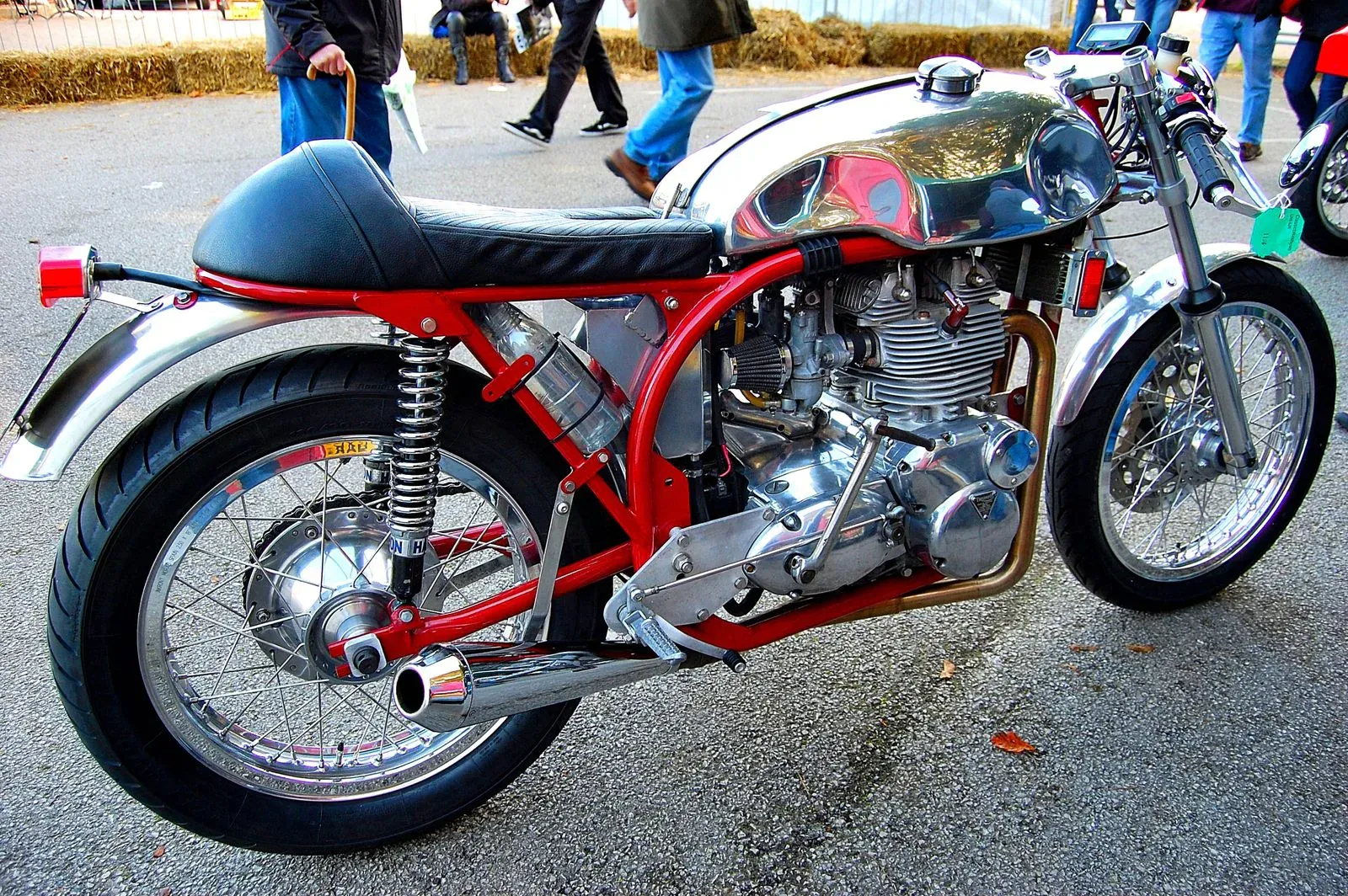
Strip away the romance and the café racer is a design philosophy, one you can read in metal. The recipe was subtraction. Take a standard motorcycle and remove everything that does not help it go faster or corner harder.
The archetype was the Triton: a Triumph parallel-twin engine, prized for its power, dropped into a Norton "Featherbed" frame, prized for its handling. It was a home-built greatest-hits machine, the best of two rivals fused by riders who cared only about the result. The BSA Gold Star, the Velocette, and the Norton itself all did their turn. None of them came café-styled from the factory. That was the whole point: a café racer was something you made, an argument you built with spanners.
It would be a mistake to remember the café racer only as a set of parts. It was a social world. Clubs formed around the cafés, most famously the 59 Club, which began life in 1959 as a youth club at a Hackney church and grew, almost by accident, into one of the best-known motorcycle clubs in the world after a young vicar started welcoming the local rockers in. The leather jacket, the white silk scarf, the studded belt: this was an identity, worn deliberately, in a Britain that was not always sure what to make of it.
That identity had an edge. The rockers, as the café racer riders came to be known, were set in the public imagination against the scooter-riding mods, and the two tribes clashed at English seaside towns in 1964 in scenes the newspapers loved and exaggerated. The moral panic faded. The style did not.
Fashions in motorcycling come and go. Faired sportbikes rose, cruisers boomed, adventure bikes conquered. Yet the café racer kept resurfacing, because the thing underneath it is timeless: the desire for a motorcycle pared down to its essence, personal, honest, and a little bit defiant.
The 2010s brought the biggest revival yet. A new wave of custom builders, gathered around workshops and events like the Bike Shed in London and brands such as Deus Ex Machina, took the old subtraction philosophy and applied it to modern donor bikes. What had been a working-class British street scene became a global craft movement, equal parts nostalgia and design.
The manufacturers noticed, and answered. Today you can buy the café racer feeling straight off the showroom floor:
The café racer endures because it was never really about a decade or a place. It was about a stance toward riding. It says a motorcycle should be personal, that less can be more, and that the best machine is the one shaped by the person who rides it. You do not need a Triton or a table at the Ace Cafe to belong to that idea. You need only the belief that a bike is at its best when everything unnecessary has been taken away, and everything that matters has been made to sing. Six decades on, that is still the most romantic sentence in motorcycling, and the most useful one.