Culture
On Any Sunday: The Film That Taught the World to Love Motorcycles
5 min read
Nearly 38 miles of public road, stone walls at 200 mph, and a lap record of 136 mph. The Isle of Man TT is the most dangerous race on earth. This is why riders keep coming back.
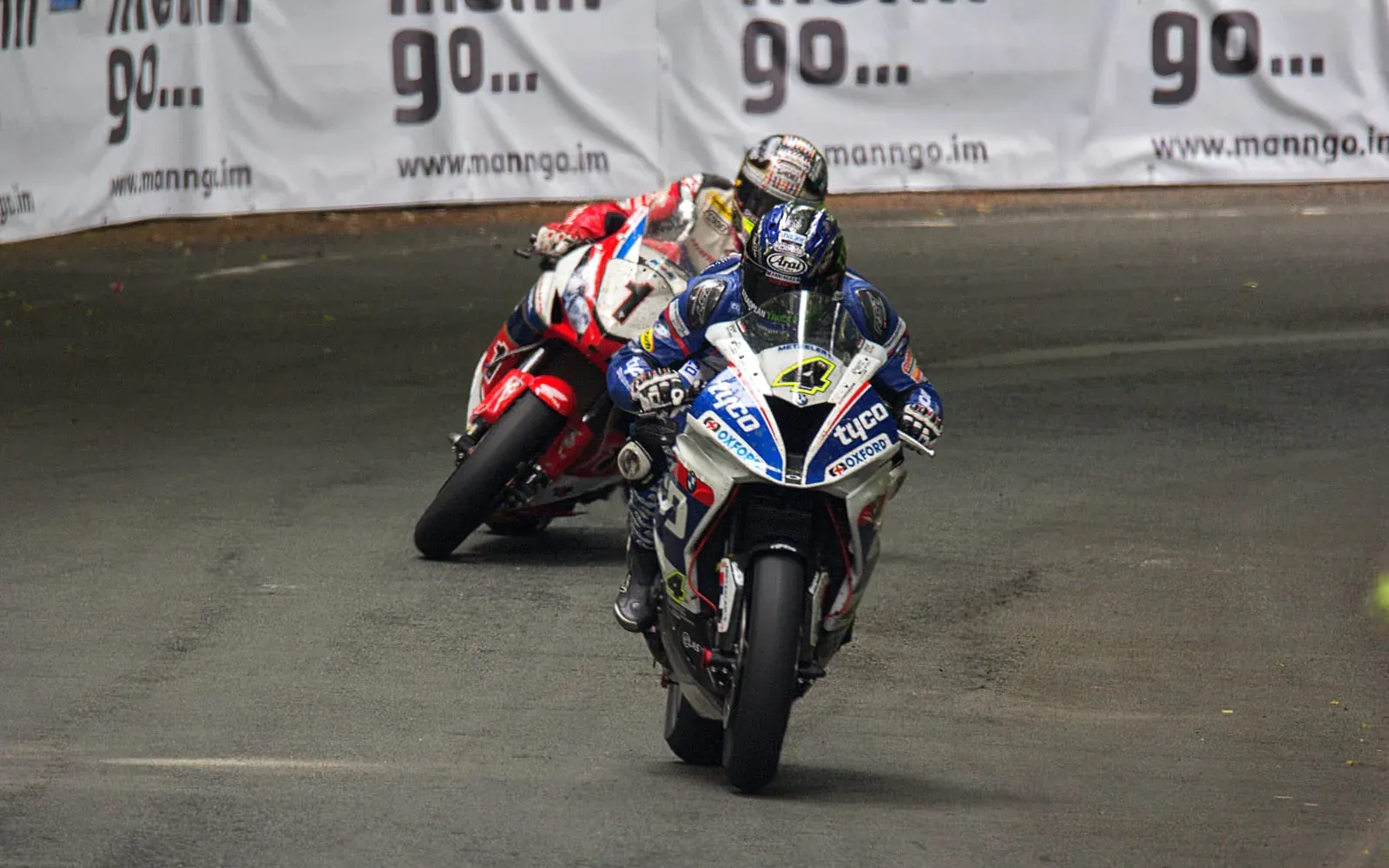
There is a stretch of the course, past the village of Ballaugh, where the road simply leaps. The riders hit a humpbacked bridge at speed and the whole motorcycle takes flight, wheels off the tarmac, a house and a pub and a low stone wall flashing past on either side. On any other racetrack in the world this would be a spectacular set-piece. On the Isle of Man it is a routine feature of a lap that also includes leafy country lanes, a mountain climb, a flat-out blast between hedgerows, and roughly 200 corners, all of them lined with the ordinary furniture of a public road. No gravel traps. No run-off. Just walls, kerbs, and consequences.
The Isle of Man TT is the oldest motorcycle race still running, and by any rational measure it should not exist. It is raced on closed public roads, not a purpose-built circuit. It has killed more competitors than any event in motorsport. And yet every year, the best road racers on the planet queue up to ride it, and hundreds of thousands of fans make the crossing to watch. To understand why is to understand something fundamental about the sport itself.
The numbers are the first thing that stops you. The Snaefell Mountain Course is 37.73 miles long, more than 60 kilometres of it, which means a single lap is longer than many riders will race in an entire weekend elsewhere. It has been the venue since 1911, and the racing began even earlier, in 1907. A rider does not memorise this course so much as absorb it, learning every crest, camber and braking marker over years of practice until the whole thing lives in muscle memory.
The speeds are barely comprehensible for a road. The outright lap record stands to Peter Hickman, set in 2023, when he covered the full Mountain Course at an average of 136.358 mph. That is an average, remember, over nearly 38 miles that includes tight villages and a mountain section. On the fastest straights the bikes are touching well over 200 mph with dry-stone walls a few feet from the handlebars. There is no other form of racing where the margin between a perfect lap and catastrophe is so thin, held for so long, at such speed.
The TT is not a race against other riders so much as a race against the island itself. You are trying to tame 37.73 miles that will never be fully tamed.
Great tracks are made by great riders, and the TT has produced some of the most revered names in motorcycling. Joey Dunlop, the quiet Ulsterman who became the event's patron saint, won 26 times across a career that made him a folk hero, and his death racing elsewhere in 2000 was mourned like the passing of a king. John McGuinness, the Morecambe Missile, built a tally of 23 wins and for years held the lap record, becoming the affable, unkillable elder statesman of the mountain.
And then there is Michael Dunlop, Joey's nephew, who in 2024 did what many thought impossible and surpassed his uncle's total to become the most successful TT rider in history. His win count now stands at 33 and still climbs. That a single family sits at the very summit of this event, across two generations and unimaginable loss, tells you everything about the peculiar gravity the TT exerts on the people who fall under its spell.
You cannot write honestly about the TT without confronting its cost. Since racing began in 1907, more than 260 competitors have died on the Mountain Course. It is not a statistic the sport hides from, and it is the reason many people believe the race should not be allowed to continue. There is no dodging the weight of that.
What complicates the argument is that the riders themselves are the fiercest defenders of the event. They are not naive about the danger; they understand it more completely than any critic ever could. They talk about the TT as the purest expression of their craft, a place where road racing skill, bravery and years of hard-won course knowledge matter more than a big budget or a perfect corporate circuit. For them it is a choice made with open eyes, and that informed consent sits at the heart of why the race survives. It is a genuinely difficult ethical question, and anyone who pretends it is simple, in either direction, is not being straight with you.
Strip away the racing for a moment and the TT is also a festival, a two-week takeover of a small island in the Irish Sea. Roads that carry commuters in the morning are closed for practice in the evening. Fans ride the same Mountain Course as the racers, at their own pace, on their own bikes, in a pilgrimage that has become a bucket-list item for motorcyclists worldwide. Bikes are everywhere: in the paddock, in the pubs, parked three deep along the promenade in Douglas. For a fortnight, an entire community organises itself around two wheels.
That communal element is a big part of the endurance. The TT is not a sterile televised product beamed in from a distant circuit. It is participatory, local and human, woven into the identity of the island that hosts it. You do not just watch the TT. You go, you ride, you stand at a hedge and feel the ground shake as the bikes go through.
In an age when top-level motorsport grows ever safer, more controlled and more corporate, the Isle of Man TT remains gloriously, terrifyingly analogue. It is a reminder of where the sport came from, when brave people raced motorcycles on the roads they lived on because there was nowhere else to do it. That authenticity is exactly what makes it so compelling and so troubling at once.
Whether the TT should exist is a debate that will run as long as the race does. But while it does, it will keep drawing the fastest, bravest riders in the world to a mountain in the sea, chasing a lap that no one can ever quite perfect. That impossible pursuit, more than any trophy, is the real heart of the myth. And it is why, every summer, they keep coming back.