Culture
The Rolls-Royce of Motorcycles: The Brough Superior SS100 and Lawrence of Arabia
7 min read
In 1969 a Japanese four-cylinder machine rewrote the rules and buried an entire industry. The story of the Honda CB750, the bike that created the template every modern motorcycle still follows.
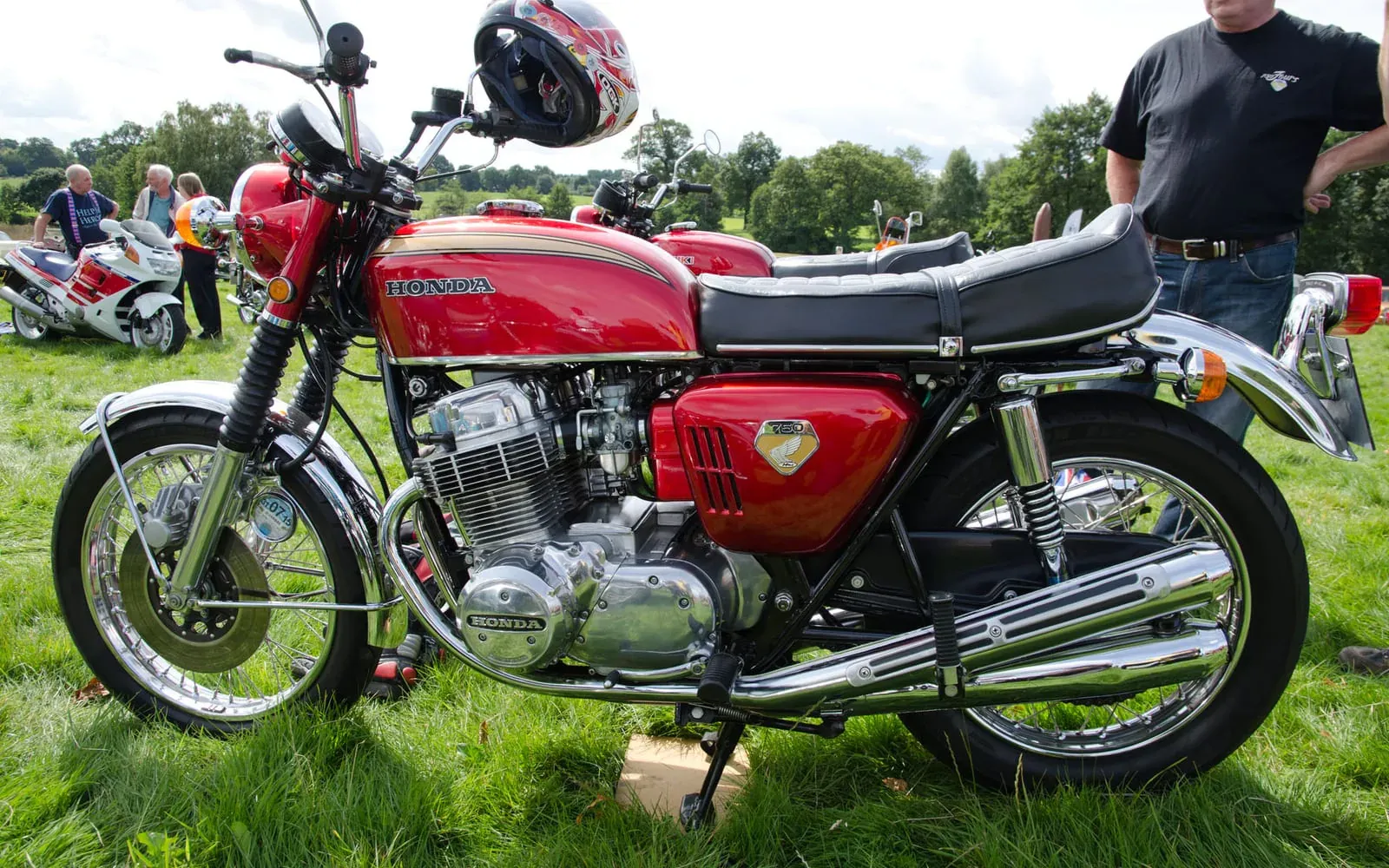
Imagine walking into a motorcycle showroom in 1969. On one side sits the establishment: a British twin, beautiful and characterful, leaking a little oil onto the floor, kicked into life by a rider who has learned its moods. On the other sits something new, shipped from Japan, and it changes the temperature of the room. It has four cylinders. It has four chrome exhaust pipes fanning out beneath it like an orchestra. It has a disc brake on the front wheel and a button that starts the engine. It costs less than the twin. Within a few years, the twin's maker will be gone. The new machine is the Honda CB750, and it did not just win the argument. It ended it.
We throw the word superbike around casually now, but it had to be invented, and the CB750 is where the word and the concept were born. To understand why every modern motorcycle, from a retro Kawasaki to a litre-class sportbike, owes it a debt, you have to understand just how radical this thing was when it landed.
At the end of the 1960s, big motorcycles were still largely a British and European affair, and they were built to a formula that had barely changed in decades: a large-capacity twin, plenty of soul, and a list of quirks the owner was simply expected to tolerate. You accepted the oil leaks. You accepted the kickstart, the temperamental electrics, the drum brakes that faded when you asked too much of them. Character and compromise came bolted together, and nobody thought there was any other way.
Honda thought there was. The company had conquered the small-bike world and now wanted the flagship class, and Soichiro Honda understood that to break in you could not simply build a slightly better twin. You had to make the establishment look obsolete overnight.
The CB750 did not beat the British bikes at their own game. It refused to play that game at all, and invented a better one.
The specification reads like a list of firsts because that is exactly what it was. At its heart sat a 736cc air-cooled SOHC inline-four, a configuration borrowed from Honda's grand-prix racers and put, for the first time, into a machine an ordinary rider could buy and use every day. It produced around 68 hp at 8,500 rpm, spun smoothly to a top speed near 125 mph, and did so with a turbine-like refinement no big twin could touch.
Then came the details that turned heads even more than the engine. The CB750 was the first mass-produced motorcycle with a hydraulic front disc brake, at a stroke making the fade-prone drums of its rivals look antique. It had an electric starter, so you pressed a button rather than performing a ritual. It had a five-speed gearbox and, crucially, it was reliable, the one quality the character-rich opposition could never guarantee. And Honda priced it at roughly US$1,495, undercutting machines it comprehensively outperformed.
Fast, smooth, powerful, civilised, dependable and affordable, all at once. Nothing had ever offered that combination. The motorcycle press reached for a new word to describe it, and superbike stuck.
The CB750's real legacy is not any single number. It is the blueprint. That transverse inline-four, mounted across the frame with an upright, do-anything riding position, became the default recipe for a big motorcycle for the next fifteen years. The industry even coined a name for the pattern: the Universal Japanese Motorcycle, the UJM, a standard-issue four-cylinder standard that every Japanese manufacturer would build its own version of.
Kawasaki answered with the mighty Z1. Suzuki came with the GS series. Yamaha followed. Each was chasing the space the CB750 had opened, and together they defined the motorcycling of the 1970s and early 1980s so completely that the shape still reads as timeless today. When you look at a modern retro roadster, a Kawasaki Z900RS or a Honda CB1000F, with its round headlight, its four-cylinder rumble and its honest upright stance, you are looking at a direct descendant of that 1969 machine.
There is a harder side to this story, and it deserves to be told honestly. The CB750 and the UJMs that followed did not just outsell the old British industry. They dismantled it. Famous names that had defined motorcycling for half a century could not match the Japanese on refinement, reliability or price, and one by one they faltered and fell. An entire manufacturing culture that had led the world was overtaken in barely a decade.
You can mourn that, and many riders still do. The character of those old machines was real, and something was lost when the future arrived in the shape of a smooth, dependable four. But it is worth being clear-eyed about what buyers were actually choosing. They were choosing brakes that worked, a bike that started every morning, and performance that had been the preserve of exotics, for the price of an ordinary motorcycle. Progress is rarely sentimental.
The Honda CB750 is the rare machine whose importance only grows with distance. In its own time it was a sensation. In hindsight it is a hinge point, the moment the motorcycle stopped being a temperamental object you managed and became a reliable machine you simply rode. Every rider who has thumbed a starter button, trusted a disc brake into a fast corner, or felt the smooth pull of a four-cylinder engine is enjoying a world the CB750 built.
The early sandcast examples are now precious collector's pieces, and a clean K-series CB750 draws a crowd at any show, as much for what it represents as for how it looks. It is the bike that drew the line between the old world and the modern one. Everything on the near side of that line, including the machines we review here every week, is living in the house the CB750 built.