Culture
Four Pipes and a Disc Brake: How the Honda CB750 Invented the Superbike
6 min read
The fastest, most expensive motorcycle of the 1920s was built by hand in Nottingham and loved to death by Lawrence of Arabia. The story of the Brough Superior SS100, the original halo bike, and the crash that changed rider safety forever.
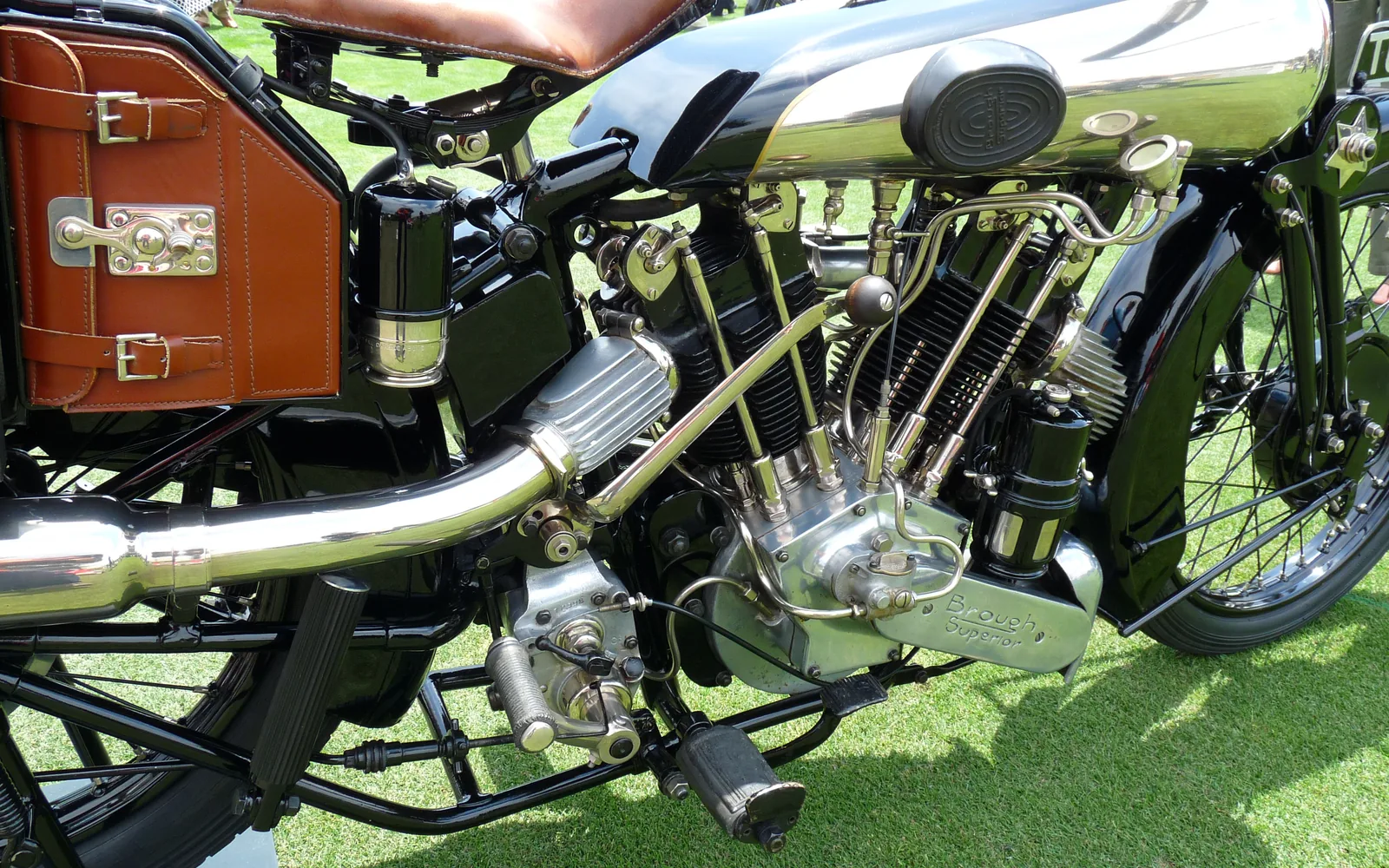
There is a stretch of Dorset lane, narrow and hedged, that a man once knew the way a musician knows a phrase. He had ridden it hundreds of times, opening the throttle where the road ran clear, feeling the big V-twin gather itself and surge. On the morning of 13 May 1935 he took it again, on the seventh of the eight motorcycles he had owned and named like sons. Two boys on bicycles appeared in a dip he could not see over. He swerved to miss them, the front wheel let go, and he was thrown clean over the handlebars. Six days later Thomas Edward Lawrence, the man the world called Lawrence of Arabia, was dead at forty-six. The motorcycle beneath him was a Brough Superior SS100, and to understand why a war hero and desert diplomat had spent so much of his life and money on such a machine, you have to understand that in the 1920s and 1930s there was simply nothing else like it on earth.
The Brough Superior was the work of one obsessive: George Brough, who began building motorcycles in Nottingham in 1919. His father, William, already made bikes under the Brough name, and the son's decision to call his own machines "Superior" was a small act of cheerful parricide that reportedly did not please the old man at all. George did not care. He was not interested in building a good motorcycle. He was interested in building the best motorcycle in the world, and then charging accordingly.
Every Brough Superior was assembled largely by hand and treated as effectively bespoke to its buyer. The build process bordered on the fanatical. Each machine, the story goes, was assembled once to check that every part fitted, then completely dismantled, its components finished and polished, and finally rebuilt for keeps. It was coachwork thinking applied to two wheels, and it produced motorcycles of a fit and finish nobody else could match.
The nickname that stuck came from a road tester who called it "the Rolls-Royce of Motorcycles," and it stuck so well that Rolls-Royce itself took notice. As the tale is told, a representative from the car maker came to Nottingham expecting to object, watched a Brough being built with that double-assembly ritual, saw the standard of the work, and gave Brough his blessing to keep using the line. Whether every detail is history or well-loved legend, it tells you exactly how the machine was regarded. This was not a fast motorcycle with pretensions. It was the genuine article, and everyone knew it.
The SS100 arrived in 1924, and its name was a promise written in the sales contract. Every single one came with a signed guarantee that it had been individually timed at over 100 mph, that is 160 km/h, before it left the works. In the mid-1920s that was an almost preposterous claim. Ordinary cars of the day struggled to reach half that. Brough was selling, in writing, the fastest road vehicle most people would ever see.
Underneath sat a large V-twin engine, bought in from JAP and in later years from Matchless, tuned and installed with the same care as everything else. The result was not just fast but genuinely, repeatedly record-breaking. On SS100s in 1927 and 1928, George Brough himself and the great tuner-racer Freddie Dixon set speed records around 130 mph, numbers that put the machine in a category all its own.
Brough did not sell the promise of speed. He sold speed already measured, timed, and signed, on a document that came with the bike.
All of this cost the earth. An SS100 ran to roughly £170 in the mid-1920s, a sum that could buy a small house. It was the most expensive motorcycle money could buy, and it was meant to be. Only around 380 to 400 SS100s were ever built through the 1930s, each one a hand-made object for a customer who wanted the ultimate and could pay for it. Remarkably, most of them survive, and today they rank among the most valuable motorcycles in the world, changing hands at auction for sums that would have stunned even George Brough.
No customer loved the machines more completely than T. E. Lawrence. The man who had helped lead the Arab Revolt, who had shaped the map of the modern Middle East and then recoiled from his own fame, found in the Brough Superior something like peace. He owned eight of them across his life, more than any other single rider of the era, and he treated them as characters rather than possessions. He nicknamed them "Boanerges," a biblical phrase meaning "sons of thunder," and numbered them George I through George VII, with an eighth already on order when he died.
Lawrence wrote about riding the way other men wrote about love. Speed, for him, was not recklessness but a kind of clarity, the roar of the twin flattening out the noise in his own head. After the vast public drama of Arabia, the open English road on a Brough was a place to be no one, to simply ride. He corresponded with George Brough directly, an ordinary customer and an extraordinary man, and the maker took obvious pride in having Lawrence's name among his buyers.
That intimacy is exactly what makes the ending so hard. Lawrence was not killed by some exotic misadventure. He was killed on a road he knew, doing the thing he loved most, on the machine he trusted more than any other.
The Brough that could not save him would, through his death, help save a great many others. Among the doctors who studied Lawrence's fatal head injury was a young neurosurgeon named Hugh Cairns. He was troubled by what he saw: a fit man in his forties, killed not by the impact of the crash itself but by the damage to his unprotected head. Cairns began to research motorcycle fatalities in earnest, and his work built a rigorous case that many of these deaths were preventable, that a hard shell around the skull could turn a fatal accident into a survivable one.
His findings became a foundation stone of the modern crash helmet. The straight line from Clouds Hill to the helmet on your own garage shelf is not sentiment. It is documented medical history. Lawrence loved speed and it killed him, and out of that loss came the single piece of equipment that has since spared countless riders the fate that took him. There is no neater illustration of motorcycling's oldest bargain, the thrill and the risk forever bound together, and no better argument for the gear we now take for granted.
Walk into any showroom in 2026 and look for the halo bike, the one on the pedestal that almost nobody will buy, priced beyond reason, built in tiny numbers, existing mostly to say what the maker is capable of. Every marque has one, and every one of them is a descendant of what George Brough built in Nottingham a century ago.
The Brough Superior invented the idea of the motorcycle as money-no-object object, hand-assembled, faster than anything else on the road, and priced like a work of art because that is what it was. Before it, a motorcycle was transport or sport. After it, a motorcycle could also be the finest thing a company knew how to make, sold to someone who wanted exactly that. The modern flagship superbike, the limited-run special with a waiting list and a price like a supercar, is running on a template Brough drew first.
And braided through all of it is Lawrence, who gave the machine its soul as surely as George Brough gave it its engineering. Romance and speed, mortality and, through Hugh Cairns, the very birth of rider safety, all of it rides pillion whenever someone tells this story. The Brough Superior SS100 was the Rolls-Royce of Motorcycles. It remains, nearly a hundred years on, the most human legend the sport has ever produced.