Culture
The Vincent Black Shadow: The World's Fastest Motorcycle, and the Man in a Bathing Suit
7 min read
An old man from the bottom of New Zealand, a 1920 Indian Scout, and forty years of hand-cast parts. The story of Burt Munro, the Munro Special, and the Bonneville record that still stands.
Picture the salt at dawn. The Bonneville flats stretch out flat and blinding white to a horizon that seems to curve away, cool enough in the early hours that your breath shows, silent except for the ticking of an engine warming up. Kneeling beside a long silver cigar of a motorcycle is an old man in his late sixties, weathered and lean, a New Zealander a very long way from home. The machine he is about to climb into is older than most of the men around him. He built much of it himself, in a shed, by hand, out of parts he cast in his own back yard. In a few minutes he will lie down inside it, point it at the horizon, and try to go faster than almost anyone has ever gone on two wheels. His name is Burt Munro, and he is about to make history on a motorcycle everyone else had written off decades ago.
Burt Munro was born in 1899 and grew up on a farm near Invercargill, at the very bottom of New Zealand's South Island, about as far from the racing world as it is possible to get. In 1920 he bought a brand new Indian Scout, a modest side-valve V-twin of around 600cc that, in stock form, was good for perhaps 55 mph. For most owners that would have been the end of the story: a decent bike, a bit of fun, a tool for getting around.
For Munro it was the beginning of a love affair that would last the rest of his life. He kept that same Scout for nearly sixty years, and for roughly forty of them he was engaged in a slow, obsessive, endless project to make it faster. Not a bit faster. Impossibly, absurdly faster. He would take a humble farm-country motorcycle and chase land speed records with it against the best-funded teams on earth.
He was not a wealthy man. He worked, he scraped, he lived simply, and he poured what he had into the machine. What he lacked in money he made up for in a quality that is harder to buy: a bottomless, single-minded refusal to stop tinkering.
The heart of the Munro legend is the shed. This is where an ordinary Indian Scout was slowly reinvented into something the factory would never have recognised. Munro had almost no proper equipment and even less budget, so he made what he needed.
He cast his own pistons in moulds packed in sand. He made his own barrels, his own flywheels, his own connecting rods, machining and filing and testing by trial and error, blowing parts up and starting again. He cut the treads into his own tyres by hand. When he needed a fuel cap, he used a cork from a brandy bottle. He tested his work on the beach at Oreti, near home, running the bike flat out along the sand to see what would hold and what would let go.
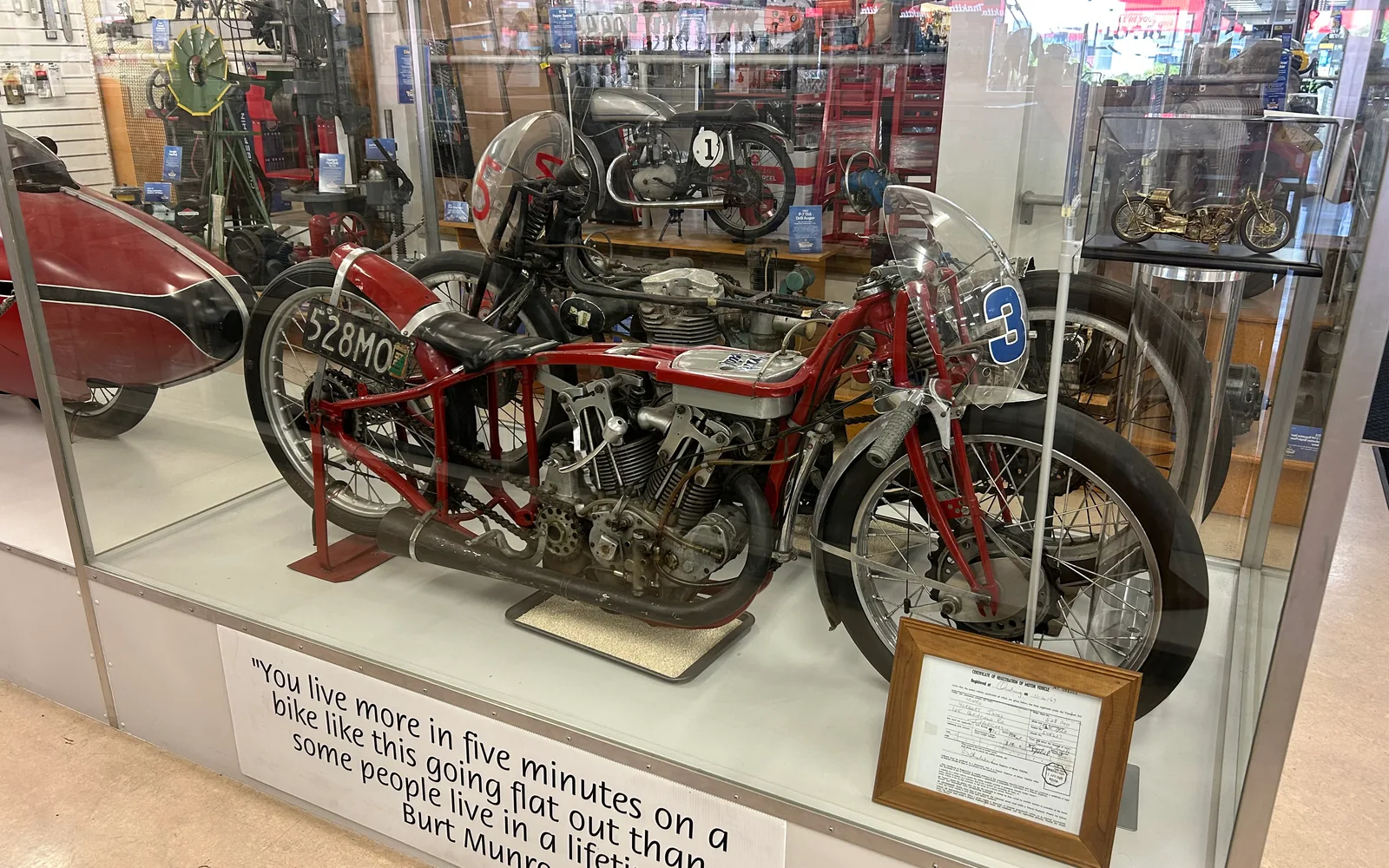
Over the decades the little 600cc Scout grew. He bored and stroked and rebuilt it until it displaced around 950cc, wrapped it in a hand-formed streamlined shell, and turned it into the machine that became known as the Munro Special. By the end it shared little more than its bloodline and its stubborn owner with the bike he had bought in 1920. Everything else was Burt, learned the hard way, one poured piston at a time.
He had almost no money and homemade parts, and he beat the best-funded teams in the world by simply refusing, for forty years, to stop.
The Bonneville Salt Flats in Utah are the cathedral of the land speed world, a vast dead-flat lake bed where machines of every kind have gone hunting for outright speed for the best part of a century. It is where you go to find out how fast your dream really is.
Munro first made the enormous journey from New Zealand to Utah in 1962, aged 63, an age when most riders have long since hung up their leathers. He would return again and again, nine trips in all, shipping himself and his machine halfway around the world on a shoestring, charming officials, borrowing tools, sleeping rough, patching the bike together between runs. He was, by then, an old man on a very old motorcycle, and he was outrunning almost everyone.
Across those years he set three official records, in 1962, 1966 and 1967. Each time he had to coax more from a machine that was already, by any sane measure, finished.
The great day came on 26 August 1967. Munro was 68 years old. His Indian was 47 years old. Together they ran the Munro Special through the timing traps in the under-1000cc streamliner class and posted an average of 184.087 mph, roughly 296 km/h. A one-way pass on the same machine was reported at close to 205 mph, a genuinely startling figure for a homemade motorcycle built around a design from the 1920s.
That class record still stood as of 2026, one of the longest-standing records in the entire sport. It is worth pausing on that. A speed set by a pensioner on a self-built machine, using parts he cast in his own back yard, has outlasted more than half a century of factory teams, aerodynamic research, and money. In 2014 the AMA revisited the timing and corrected an old calculation error, formally crediting Munro with that 184.087 mph figure and tidying the record books in his favour.
For most people alive today, the way into this story is a film. In 2005 Anthony Hopkins played Munro in The World's Fastest Indian, a warm, romantic telling of the old man's journey from his Invercargill shed to the Utah salt. It introduced Burt Munro to millions who had never heard of land speed racing, and it made him, at last, famous.
Like any film, it smoothed the edges and heightened the romance. The real Munro was tougher, odder and more bloody-minded than any two-hour story can capture, a man who lived and breathed his machine to a degree most of us would find hard to imagine, and who paid for his obsession in ways the screen only hints at. But the film got the essential thing right. Here was a man with no money and no team and no reason to succeed, who succeeded anyway, on his own terms, because he could not do otherwise. The myth and the man point in the same direction.
You do not have to want a land speed record to understand Burt Munro. If you have ever stood in a cold garage at midnight with a part that will not fit, chasing a problem nobody asked you to solve, on a bike nobody told you to build, you already know exactly who he was.
His story is the purest expression of the garage-tinkerer spirit that runs through all of motorcycling: the belief that ingenuity beats budget, that obsession is a kind of gift, and that a motorcycle can be a lifelong love affair rather than a possession you trade in every few years. He belongs to the same restless family as the Bonneville land speed subculture that still gathers on the salt every year, and to the long, proud heritage of Indian Motorcycle, whose humble Scout he turned into a legend.
The bike Munro loved was, by every rational standard, the wrong bike. Too old, too small, too slow, too cheap. He kept it anyway, and made it the fastest Indian in the world. That is the part worth carrying out to your own shed. The machine in front of you does not have to be the best one. It only has to be the one you refuse to give up on.