Culture
On Any Sunday: The Film That Taught the World to Love Motorcycles
5 min read
He broke more bones than any human should survive, cleared buses and canyons in a star-spangled leather suit, and made a whole generation believe a motorcycle could fly. This is the story of Evel Knievel, and why the myth still lands harder than the jumps ever did.
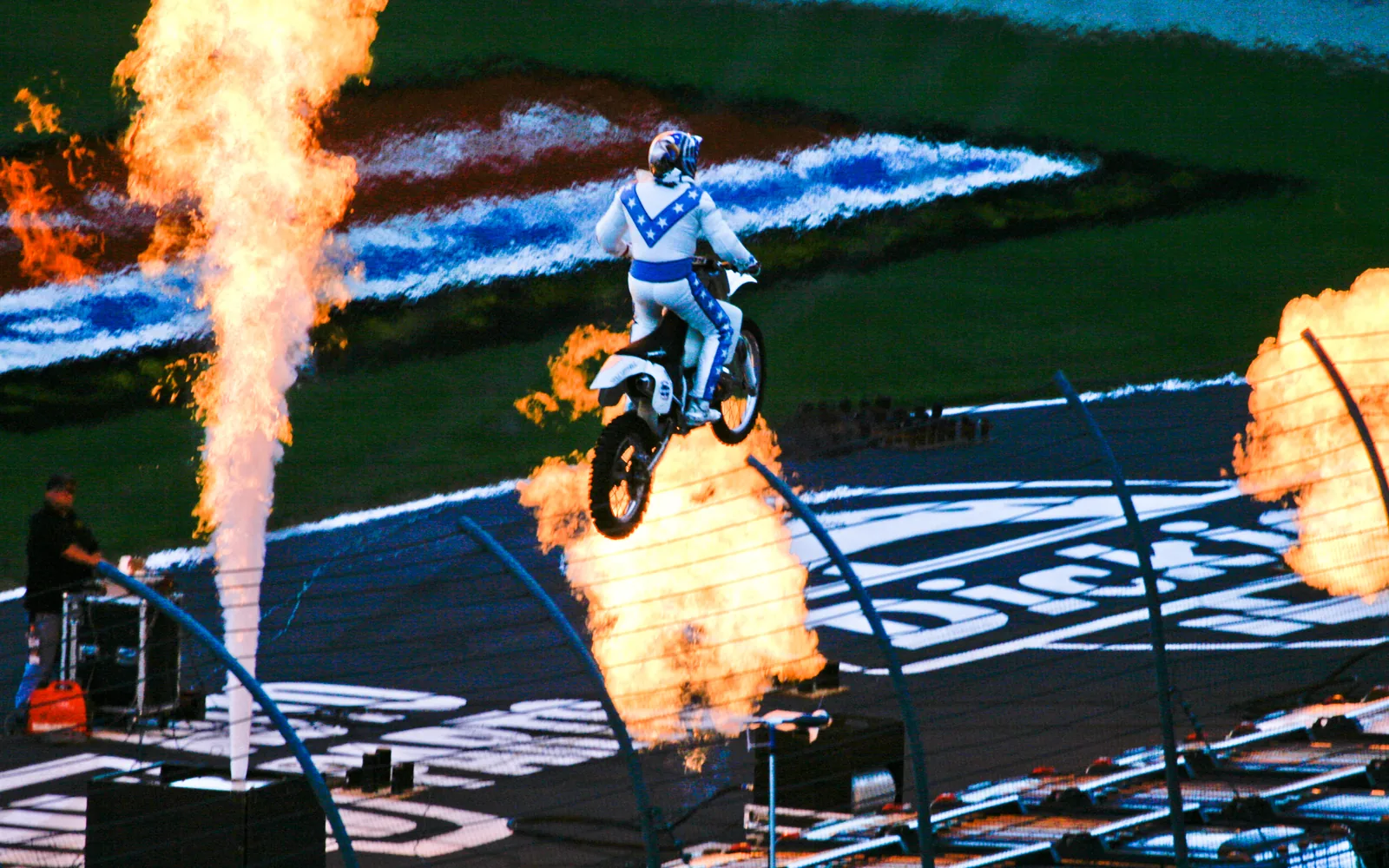
On New Year's Eve, 1967, a 29-year-old former insurance salesman from Butte, Montana, twisted the throttle of a Triumph and launched himself over the ornamental fountains outside Caesars Palace in Las Vegas. He cleared them. Then the landing went wrong, catastrophically, and the film of his body cartwheeling across the tarmac like a rag doll would be replayed for decades. He shattered his pelvis and femur, broke his hip, ankle and wrist, and suffered a concussion. He also, in that single failed jump, became famous forever.
That is the paradox at the heart of Evel Knievel. He is remembered less for the jumps he made than for the ones he did not quite. He sold, more than anything, the beautiful terror of a man who might not get up, and then got up anyway.
Robert Craig Knievel was many things before he was a legend: a miner, a soldier, a semi-pro hockey player, a small-time hustler with a gift for talking. What he understood, earlier and better than anyone, was that people will pay to watch someone risk everything. He assembled an act out of that insight, a travelling motorcycle daredevil show, and dressed it in a costume borrowed straight from Liberace by way of Captain America: white leather, red and blue stars, a matching cape and cane.
The look mattered. Knievel grasped that he was not really selling stunt riding, he was selling a character, an American folk hero in the making who happened to use a motorcycle as his instrument. By the time he found his signature machine, the flat-track-derived Harley-Davidson XR-750 that he jumped from late 1970 through much of the decade, the persona was complete. The bike was almost a supporting actor.
The catalogue of stunts is staggering, and so is the injury list that shadows it. Across his career Knievel attempted dozens of ramp-to-ramp jumps over cars, buses and trucks, and the legend, endlessly repeated, holds that he broke more than 400 bones in the process, a figure enshrined for years in the record books. Whether the true count is that high almost misses the point. What is certain is that he was hospitalised again and again, and kept climbing back onto the ramp.
The Caesars Palace crash made his name. His attempt to clear a row of double-decker buses at London's Wembley Stadium in 1975 ended in another brutal tumble, after which he announced his retirement to the crowd from the ground, before, inevitably, un-retiring. And then there was the one that was not really a motorcycle jump at all.
By 1974 the jumps had grown so large that no motorcycle could make them, so Knievel simply commissioned a rocket. On 8 September 1974 he sat in the Skycycle X-2, a steam-powered contraption pointed up a ramp on the rim of Idaho's Snake River Canyon, and lit it. The machine roared off the rail, but a drogue parachute deployed too early. The Skycycle drifted across to the far rim, then the wind pushed it back into the canyon, where it settled near the water. Knievel walked away with minor injuries.
It should have been a humiliation. Instead it may be the most perfectly Knievel moment of all: an audacious, faintly absurd, enormously watched failure that only deepened the myth. He had promised the impossible, attempted it in front of the world, and survived. That was always the real product.
It is easy, now, to file Knievel under kitsch, the cape, the toys, the Vegas glitz. That undersells what he built. He turned motorcycle stunt riding from a fairground sideshow into mass entertainment, and in doing so he planted a seed that grew into an entire culture. Every freestyle motocross backflip, every Nitro Circus ramp, every X Games gold medal traces a line back to a man in white leather betting his skeleton against a row of buses.
His influence on the wider image of motorcycling is harder to measure but just as real. To millions of children in the 1970s, waving an Evel Knievel stunt-cycle toy across the living-room carpet, a motorcycle was not a threat or a mode of transport. It was a machine that could fly, ridden by a hero who did not know how to quit. That romance, the idea that a bike is an instrument of the impossible, still hums under the sport today.
Knievel died in 2007, his body a museum of old fractures, having outlived nearly every prediction that one of his stunts would kill him. Decades later, Travis Pastrana would honour him by clearing, in a single Las Vegas night, distances Knievel could only dream of, on modern machinery Knievel never had. Pastrana landed them all. And yet it is Knievel we still talk about, because the jumps were never the point.
The point was the getting up. In a sport that celebrates control, precision and the clean line, Evel Knievel stood for something messier and more human: the sheer, stubborn refusal to stay down. He fell more spectacularly than anyone before or since, and every single time, star-spangled and shattered, he found a way to stand back up and grin at the crowd. That is why the myth still flies, long after the wheels stopped turning.