Culture
The World's Fastest Indian: How Burt Munro Chased 200 mph on a Homemade Machine
7 min read
In 1948 a hand-built British V-twin could out-run almost anything on the road, and a man named Rollie Free stripped to his swim trunks to prove it on the Bonneville salt. The story of the Vincent Black Shadow, an engineering masterpiece decades ahead of its time.
There is a photograph, taken on the Bonneville Salt Flats in September 1948, that stops people in their tracks the first time they see it. A motorcycle is flat out across the white, and its rider is not sitting on it in any normal sense. He is lying face down, stretched full length along the machine, legs trailing off the back, chin almost on the rear mudguard. And he is wearing, against every instinct of self-preservation, nothing but a pair of swimming trunks, a borrowed bathing cap and a pair of sneakers.
The man was Rollie Free. The motorcycle was a Vincent. And the reason he had peeled off his leathers and lain down like a man diving into water was simple: this British V-twin was the fastest motorcycle in the world, and Free was about to prove it in the most extraordinary way anyone ever has.
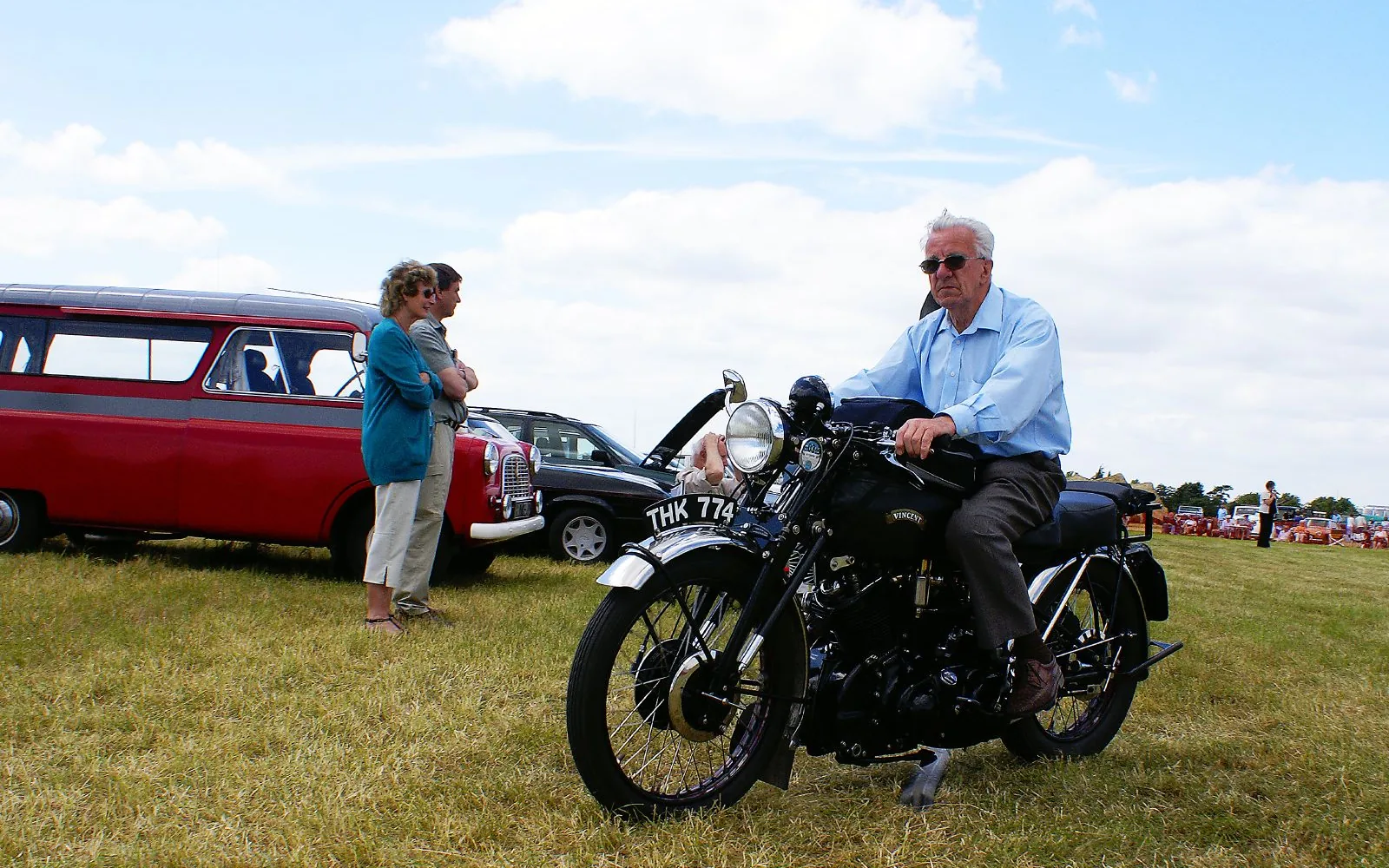
To understand the photograph you have to understand the machine, and to understand the machine you have to understand how absurd it was for its time. When the Vincent Black Shadow arrived in 1948, most road motorcycles were good for 70 or 80 mph and felt busy doing it. The Black Shadow, straight off the showroom floor, would do around 125 mph. Nothing else you could simply buy and ride home came close.
Vincent, based in Stevenage, north of London, knew exactly what it had built and was not shy about it. The company advertised the Black Shadow as "the world's fastest production motorcycle," a claim rivals could only grind their teeth at. To leave no doubt, Vincent fitted it with a vast five-inch Smiths speedometer reading all the way to 150 mph, and finished the big V-twin engine in black enamel, the detail that gave the bike its name and its brooding, unmistakable presence.
The Black Shadow was not fast by brute force alone. It was fast because it was clever, the work of two exceptional minds: company founder Philip Vincent and his brilliant Australian chief engineer, Phil Irving. Between them they produced a motorcycle so far ahead of its contemporaries that some of its ideas would not become mainstream for another thirty or forty years.
The 998cc air-cooled V-twin made around 55 hp, a huge figure for 1948. But the genius was in the architecture. There was, in effect, no conventional frame: the engine itself was a stressed member, bolted into a compact structure with the oil tank forming the backbone above it, saving weight and adding rigidity in a way the industry would not widely copy until far later. At the back sat a cantilever rear suspension system, a direct ancestor of the monoshock arrangements every modern sportbike now uses. There were twin brakes on each wheel to haul down all that speed, a Girdraulic front fork, and an obsessive degree of adjustability: the footrests, the brake pedal, the seat and more could all be set to the rider.
It was, in short, a thinking person's motorcycle, built to a standard of engineering that made it expensive to produce and, eventually, impossible to sustain. But in 1948 it was simply the most advanced thing on two wheels.
| The Vincent Black Shadow | |
|---|---|
| Made | Stevenage, England, 1948-1955 |
| Engine | 998cc air-cooled 50-degree V-twin |
| Power | Around 55 hp |
| Top speed | Around 125 mph (road trim) |
| Speedometer | 5-inch Smiths, reading to 150 mph |
| Landmark features | Engine as stressed member, cantilever rear suspension, twin brakes per wheel |
| Racing version | Black Lightning |
The racing version of the Black Shadow was the stripped, tuned Black Lightning, and it was one of these that carried Rollie Free onto the salt in 1948, chasing the American motorcycle land speed record on behalf of the bike's American importer.
Free made his first attempts in the way any sane man would, wearing full leathers. He got to around 147 mph and could not find the last few. The problem, he reasoned, was drag. His bulky leathers were acting like a sail, and his own body, sitting upright, was the biggest brake on the bike. So he made a decision that has passed into legend. He took the leathers off. Wearing only a pair of borrowed swimming trunks, sneakers and a bathing cap, to cut every possible ounce of wind resistance, he lay flat along the length of the motorcycle, feet stretched out behind him, and ran it again.
He recorded 150.313 mph, a new American record, and one of the photographs of that prone, near-naked run became the single most famous image in motorcycling history. It is reckless and beautiful and slightly insane, and it captures something true about the whole endeavour: the willingness to risk everything, in the least dignified way imaginable, for a number.
He took off his leathers, lay flat in his swimming trunks at 150 miles an hour, and rode straight into legend. No helmet worth the name, no protection, nothing between him and the salt but nerve.
A motorcycle this good was always going to be a commercial problem. The Vincent was largely hand-built, costly and slow to produce, and by the mid-1950s the company could no longer make the numbers work. Production ended in 1955. Philip Vincent had built the finest motorcycles of their age and, in doing so, priced them beyond survival.
But the legend only grew. The Black Shadow and its racing sibling became the holy grail of the vintage motorcycle world, spoken of in the same reverent tones enthusiasts reserve for the rarest cars. Their value has climbed to heights that would have astonished the men who built them: a Black Lightning changed hands at auction in 2018 for close to a million dollars, at the time a world record for any motorcycle. Writers and musicians kept the flame alive too, from Hunter S. Thompson's fevered prose to the folk ballad that immortalised a 1952 Vincent in song.
The Vincent Black Shadow matters for two reasons, and they pull in different directions. It matters as an engineering landmark, proof that a small British firm, thinking hard and refusing to follow the herd, could leap decades ahead of everyone else and build ideas the whole industry would one day adopt as standard. Every time a modern sportbike uses its engine as a stressed member or damps its rear wheel through a single shock, there is a faint echo of Stevenage in it.
And it matters as a story, because of a man who wanted a number badly enough to lie down at 150 mph in his swimming trunks. That image is the perfect distillation of what makes land speed racing, and motorcycling itself, so strange and so magnetic: the meeting of cold, careful engineering with reckless human nerve. The bike was the cleverest thing on the salt. The rider was the bravest, or maddest. Together, for one run, they were the fastest, and the sport has never quite forgotten the sight of it.