Culture
On Any Sunday: The Film That Taught the World to Love Motorcycles
5 min read
It began with one man lost in the Sahara and a sentence that became a creed. This is the story of the Dakar Rally, the two-week test of navigation, endurance and nerve that remains the ultimate proving ground on two wheels.
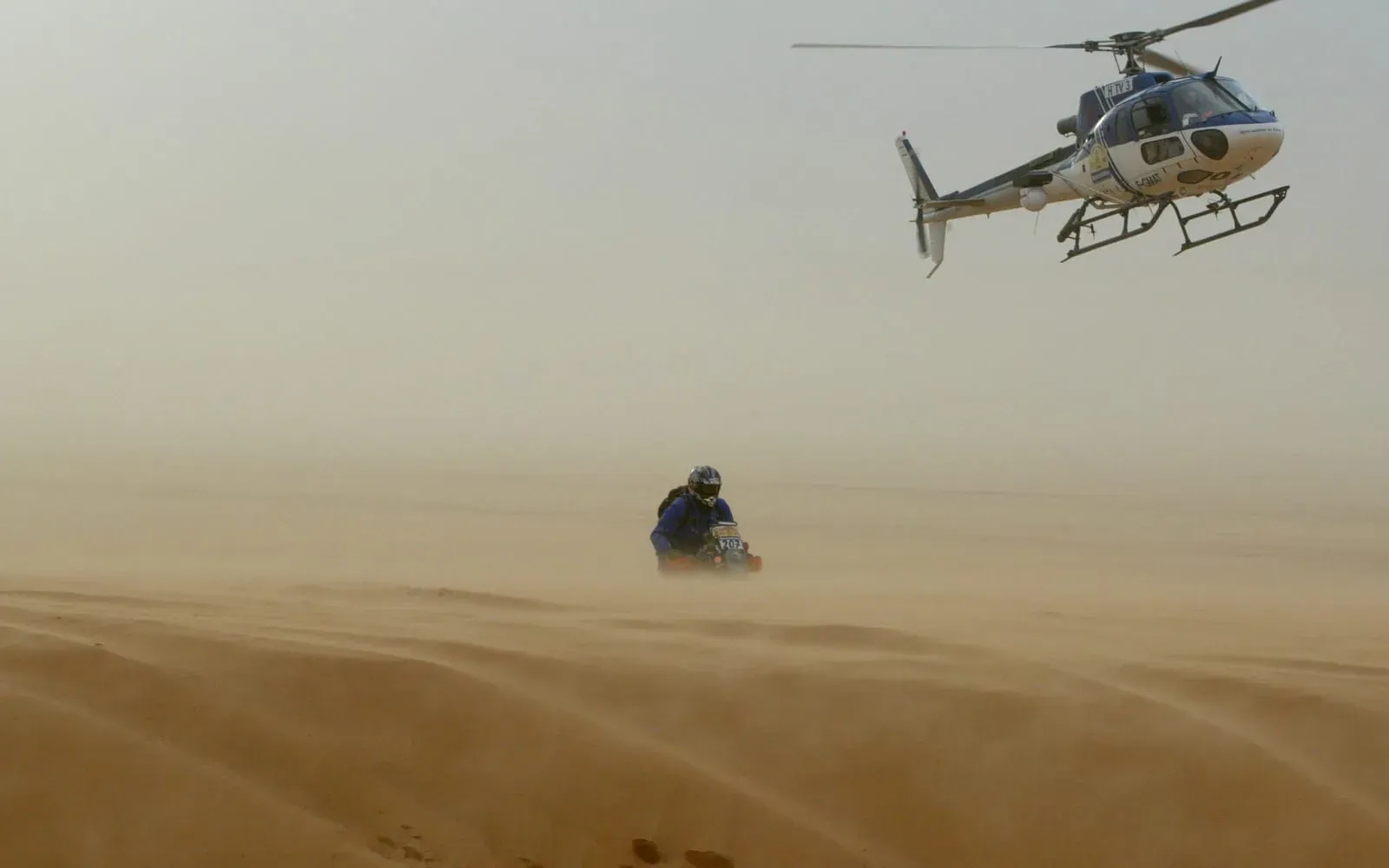
Picture a single rider, alone in an ocean of sand, a plume of dust hanging behind a motorcycle that is the only man-made thing for fifty kilometres in any direction. Above, a helicopter clatters, the only witness. There is no line painted on the ground, no crowd, no braking marker. There is a roadbook clipped to the handlebars, a compass heading, and the vast, indifferent geometry of the desert. This is the Dakar, and it is unlike any other motorcycle race on earth because, at its heart, it is not really a race against other people at all. It is a race against the emptiness, and against yourself.
The whole thing started because Thierry Sabine got lost. In 1977, the young French racer was competing in the Abidjan-Nice rally when he wandered off course and became stranded in the Ténéré, the great sand sea of the Sahara. Most people who survive that experience never want to see sand again. Sabine came out of it transfixed. He had found, in the terror and the silence, something he thought the world needed to feel, and he resolved to bring people there.
The first Paris-Dakar left the Place du Trocadéro in December 1978, bound across Europe, the Mediterranean, and the width of the Sahara for the Senegalese capital. Sabine gave his event a motto that still defines it: a challenge for those who go, a dream for those who stay behind. That single sentence is the key to understanding the Dakar's grip. It was never sold as a sport. It was sold as an odyssey, open to anyone brave or foolish enough to try.
Sabine himself died in the desert he loved, killed in a helicopter crash during the 1986 event. The race carried his myth forward rather than burying it. To this day the Dakar is haunted and hallowed in equal measure, a thing that has taken lives and still, every January, calls people back.
To grasp what makes the Dakar the hardest race in motorcycling, forget lap times. A Grand Prix is a sprint of perfect laps. The Dakar is roughly two weeks of stages, some of them over 800 kilometres in a single day, ridden across dunes, rock, gravel, mud, and fesh-fesh, the fine talcum-powder sand that swallows a front wheel without warning.
Three things make it uniquely brutal for a motorcyclist:
That combination, of physical endurance, mechanical sympathy, and the cold mental discipline of navigating while exhausted, is why rally-raid riders are regarded across motorcycling as a breed apart.
For nearly two decades the Dakar had a king, and it wore orange. KTM won the motorcycle category every single year from 2001 through 2019, one of the most dominant runs in all of motorsport, built on the now-legendary 450 rally platform and a production of desert specialists no one could match. Names like Cyril Despres and Marc Coma, five-time winners apiece, defined an era, trading the trophy back and forth across the dunes of Africa and, later, South America.
Before them stood Stéphane Peterhansel, who won the bike class six times in the 1990s before switching to cars and winning many more, earning the nickname "Mr Dakar" for a record that may never be beaten. The streak finally broke in 2020, when Honda's Ricky Brabec ended KTM's reign, proving that even a dynasty of that scale eventually meets the desert's habit of humbling everyone.
Here is the part that keeps the Dakar's soul intact: the factory stars are only half the story. Behind the works teams rides an army of amateurs, privateers who saved for years, prepared their own bikes, and entered simply to find out if they could finish. The purest of them ride in the original, unassisted class, doing their own spannering each night after a full day in the saddle, sleeping little, and starting again at dawn.
That is Sabine's dream made real, decades on. The Dakar remains one of the very few events in world sport where a total unknown can line up on the same start ramp as a world champion and face exactly the same desert. The professional is chasing a win. The amateur is chasing the finish line, and in the culture of the rally the two are held in almost equal esteem, because both are chasing the same thing Sabine found when he got lost: a version of themselves that only the desert can reveal.
The modern Dakar no longer runs to Dakar. Security concerns in Mauritania forced the 2008 event to be cancelled outright, and the rally reinvented itself first across the deserts and altiplano of South America through the 2010s, and from 2020 in the vast dunes of Saudi Arabia. Purists debate the moves endlessly. But the essential character has survived every relocation, because the Dakar was never about a particular map. It was about a particular feeling.
You will almost certainly never ride the Dakar, and that is fine. Its value to the rest of us is not as an entry form but as an idea: proof of what a motorcycle and a determined human can do when the road runs out entirely and there is nothing left but sand, a heading, and nerve. The next time your adventure bike's screen shows a turn-by-turn arrow, spare a thought for the rider with a paper roadbook and no idea what is over the next dune, chasing a dream a lost Frenchman had in the Sahara nearly fifty years ago. If that idea stirs something in you, our guide to the best adventure motorcycles of 2026 is where the daydream starts.